UNIVERSITY OF SOCIAL SCIENCES AND HUMANITIES
FACULTY OF ENGLISH LINGUISTICS & LITERATURE

Unit 4E
WRITING
A STORY OF SURVIVAL
Prepared by:
Tran Thi Thuy Tien
Le Thien Thanh Phuong
Tran Ngoc Quynh Huong

Coursebook
Class profile
LIFE: Pre-Intermediate - NatGeo
50 non-English majors at pre-intermediate level
Timetable fit
Students have already worked on using simple past tense, past continuous, and prepositions of time to tell a story. Students have already worked on vocabulary related to personal qualities and geographical features to tell a story.
Main aim(s)
To practice writing skill to tell a true story
Subsidiary aims
Students can write a true story in an appropriate organization with essential information.Students can use -ly adverbs to make a story more interesting.
Assumption
Students can use simple past tense and past continuous to describe past events.
Anticipated problem(s)
Students may not be very active during the lesson.Students may have less student talking time due to large class size.
Possible solution(s)
Redesigning some tasks in the course book to engage students. Incorporating group work and activities to increase student talking time and reduce teacher talking time
Timing
Procedure
Stage aims
Aids & materials
Interaction pattern
5 mins
WARMER
- Ss watch three stories from three viral videos on social media.
- Ss guess the endings of these stories.
- Ss volunteer to give answers and get a small reward.
- To engage students into a new lesson
- To introduce the topic of the lesson.
- Videos, slides
- T - Ss
10 mins
READING INPUT
- Ss work in groups, read a true story and identify which information is included.
- Ss check their answers with their group mates.
- Slap the board: Pieces of information are written on the blackboard. T reads the story aloud sentence by sentence. Each group sends a representative to slap on information mentioned in each sentence.
- To provide input for subsequent writing activities
- To reduce students’ anxiety
- To engage and motivate learners
- Task 2, page 53, course book
- Black board, markers, sticks to slap the board
- Ss - Ss
- T - Ss
15 mins
GRAMMAR
Using -ly adverbs in stories
- T asks ss to underline adverbs with -ly in the story in exercise 2.
- T demonstrates by pointing out 1 example from the text.
- Ss are given 3 mins to underline all the adverbs they find in the text.
- T asks some ss to give answers and then give feedback.
- T directs ss' attention to 3 uses/rules of adverbs in the text by pointing out 3 examples and explaining.
- T asks ss to match the adverbs they found with the correct uses.
- Ss are given 2 mins to do the activity.
- T may ask 1 or 2 ss or the whole class to give answers then give feedback.
- T summarises the rules and explains how to use adverbs with -ly correctly.
- To provide input for subsequent writing activities
- To engage and motivate learner
- Slides
- Baamboozle
- T - Ss
- Ss - Ss
- T directs ss’ attention to exercise 5 and gives instructions.
- Ss are given 4 mins to do the exercise.
- T shows a quiz with questions from the exercise.
- Ss give their answers and listen to T's feedback.
15 mins
CONTROLLED PRACTICE
- T assigns Ss into groups of five.
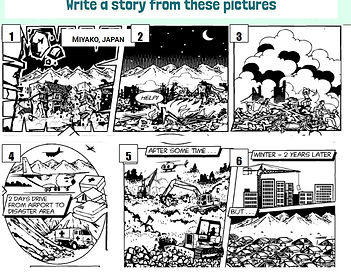
- T shows the pictures that tell a survival story and writing prompts.
- T tells Ss that they are going to write a story based on the pictures and prompts.
- T gives Ss examples of how the beginning of the story is written based on the pictures and prompts.
- Each group is provided with a paper sheet with pictures and writing prompts, markers and tape.
- Ss are given 7 minutes to continue the story based on the remaining prompts.
- Some groups are randomly/ voluntarily chosen to display their story on the board/ wall.
- The whole class read the chosen stories and give some feedback.
- T gives feedback on the chosen stories.
- To give students guided practice on writing skill
- To reduce student anxiety and promote cooperative learning
- To encourage peer feedback
- A1/ A2 sheets, markers, tape
- Ss - Ss
- T - Ss
- Peer feedback
- Teacher feedback
Homework
FREE PRACTICE
- At home, ss practice writing a true story using language and knowledge input learnt from today's lesson.
‘Write a true story. It can be from your own life or a story you read in the newspaper.”
- Ss submit their writings to T for feedback.
- To practice writing freely based on their own ideas and knowledge
- Task 6, page 56, course book
- Individual work